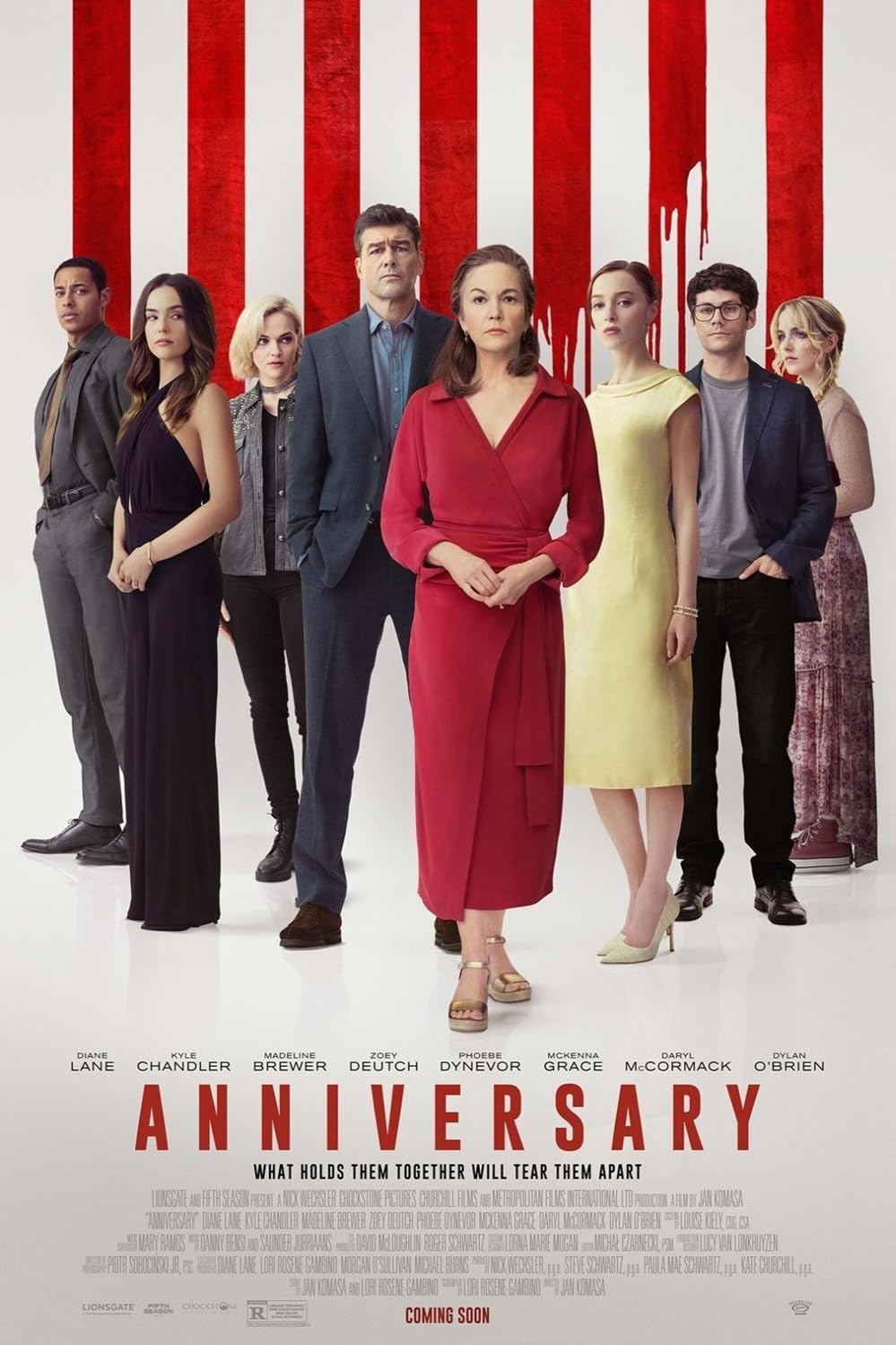
Director : Jan Komasa
Screenplay : Lori Rosene-Gambino
Starring : Diane Lane, Kyle Chandler, Madeline Brewer, Zoey Deutch, Phoebe Dynevor, Mckenna Grace, Daryl McCormack, Dylan O'Brien
Running Time : 111 minutes

“Anniversary” (2025), directed by Jan Komasa, unfolds as a tense, haunting reflection on modern authoritarianism told through the intimate lens of one seemingly perfect American family. The film opens with a sense of composure and privilege, only to peel away layers of civility until all that remains is a portrait of moral collapse and fear.
From its very first frames, the movie immerses you in an atmosphere of uneasy quiet. The Taylor family gathers in their immaculate Georgetown home, celebrating twenty-five years of marriage between Ellen, a respected professor, and Paul, a successful restaurateur. Everything appears harmonious, yet Komasa’s restrained camera movements and Danny Bensi and Saunder Jurriaans’s unsettling score hint that this calm is deceptive.
The celebration, meant to be warm and familial, becomes the spark of a political and psychological descent. When Josh, the son, arrives with his fiancée Liz, the family dynamic begins to shift. Liz, played with chilling precision by Phoebe Dynevor, carries an ideology that soon begins to infect the entire narrative. Her polite demeanor hides an unsettling conviction about reshaping democracy itself, symbolized through a new political manifesto titled The Change: The New Social Contract.
Diane Lane’s Ellen immediately recognizes Liz as a former student she once challenged for her extremist ideas. This revelation sets in motion the film’s central conflict — the battle between conscience and complicity, between the individual and the ideological collective. Komasa uses this confrontation as an entry point into the slow erosion of truth and morality in a world that increasingly rewards submission.
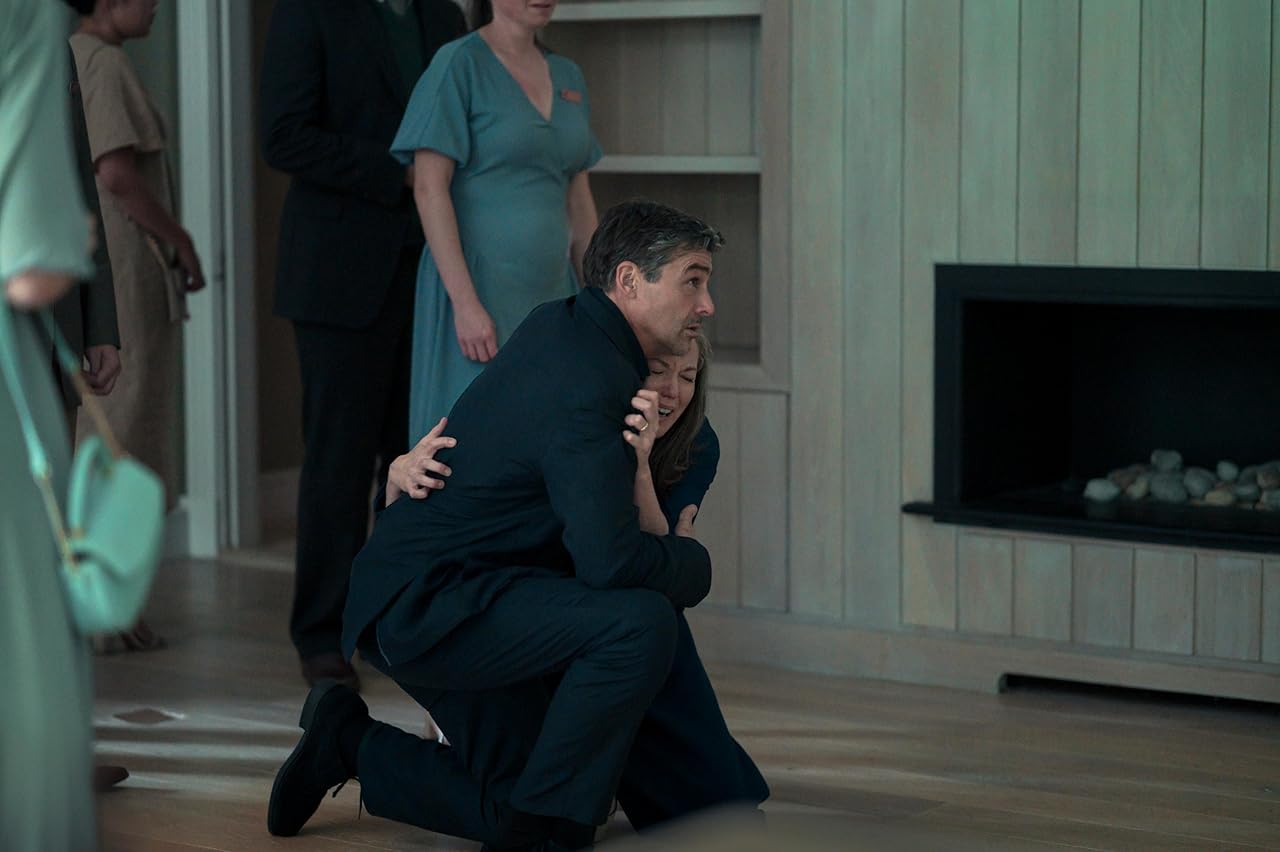
As time passes, the Taylors find their world transforming under the influence of The Change. What once seemed theoretical becomes terrifyingly real. Subtle details — altered news headlines, flags redesigned to symbolize unity, whispers of surveillance — gradually accumulate until the family’s personal lives are indistinguishable from political chaos.
Jan Komasa, known for his sharp and emotionally charged storytelling in films like Corpus Christi and The Hater, crafts a narrative that never shouts its message. Instead, it lingers in silence, allowing tension to fester beneath polite conversation and forced smiles. Every dinner scene feels like a psychological battlefield.
Diane Lane delivers a tour de force performance, portraying Ellen as both resilient and tormented. Her initial intellectual confidence slowly unravels into despair as she witnesses her loved ones succumb to manipulation. Kyle Chandler, as her husband Paul, gives the film a quiet emotional anchor. His understated expressions of confusion and heartbreak reveal the pain of a man watching the foundations of his life crumble before him.
Zoey Deutch, portraying the eldest daughter Cynthia, brings a powerful vulnerability to her role as a woman torn between loyalty and disillusionment. Mckenna Grace’s Birdie represents the fading idealism of youth — a voice of hope that gradually drowns in a society that punishes resistance. Dylan O’Brien, playing Josh, undergoes a chilling transformation from insecure son to ideological zealot, a performance that feels both tragic and disturbingly plausible.
Komasa’s decision to shoot in soft, cold tones mirrors the film’s descent into dystopia. Cinematographer Piotr Sobociński Jr. frames each scene with careful restraint, allowing the environment — the modern architecture, the sterile spaces, the reflective glass — to echo the moral emptiness developing within the characters.
As the narrative progresses through successive years, the Taylor family’s story becomes a microcosm of a nation’s downfall. By the time Ellen loses her academic position and propaganda replaces conversation, the film has fully evolved into a nightmare of conformity. Yet even in its bleakest moments, Komasa refuses to indulge in hopelessness. He grants his characters — and by extension, the audience — fleeting moments of resistance that feel heartbreakingly human.
One of the most striking sequences takes place during a Thanksgiving dinner, where old family tensions erupt under the shadow of political ideology. Every line of dialogue cuts deeper than the last, and when Liz’s manipulations come to light, the audience is left holding its breath. Komasa directs the scene with precise emotional rhythm, transforming a domestic argument into an allegory for societal collapse.
By the film’s final act, chaos and tragedy are inevitable. As Birdie’s desperate act of rebellion culminates in a shocking moment of violence, the Taylor family is shattered beyond recognition. Yet Komasa refuses to end with spectacle alone. The quiet aftermath — Liz’s conflicted expression as she gazes at a family photograph — leaves a haunting question about power, guilt, and the price of ambition.

The film’s pacing, though deliberate, allows the tension to breathe. Moments of stillness feel heavy with dread. Komasa’s use of silence and space recalls the controlled precision of European cinema, particularly his Polish roots, yet his exploration of American politics feels both authentic and urgent.
Critics have noted that Anniversary deliberately avoids specifying political alignments, allowing it to exist as a universal warning rather than a partisan statement. That ambiguity is its greatest strength. It invites reflection rather than dictating interpretation. Viewers are left to confront their own fears about where control ends and submission begins.
The supporting cast amplifies this thematic resonance. Madeline Brewer’s Anna, a comedian turned dissident, embodies art’s fragile place in times of repression. Daryl McCormack’s Rob, struggling with his wife’s disillusionment, offers one of the film’s most heartbreaking subplots. Each character, however brief their screen time, contributes to the tapestry of collapse that Komasa carefully weaves.
Composer Danny Bensi and Saunder Jurriaans’s music deserves special mention. Their score flows like an undercurrent of unease, blending classical motifs with dissonant electronic tones that echo the story’s moral dissonance. By the time the final notes fade, the music feels inseparable from the film’s emotional core.
The reception of Anniversary has been polarized, and perhaps rightly so. Some critics praise its fearless confrontation with themes of authoritarianism, while others argue that its political neutrality undermines its urgency. Yet even those who find flaws acknowledge its craftsmanship and the intensity of its performances.
The film’s emotional power lies not in grand speeches but in small gestures — a glance, a silence, a hand trembling over a dinner plate. Each moment builds a sense of inevitability that is more frightening than any overt act of violence. Komasa shows how tyranny begins quietly, in the compromise of truth and the erosion of empathy.
By the conclusion, when law enforcement invades the Taylor home and the family’s fate is sealed, the imagery recalls the great works of political allegory. It’s impossible not to think of Pasolini’s Teorema or even The Lovers by Magritte, referenced within the story itself — two lovers blinded and bound, still reaching for each other despite the suffocating fabric between them.
Anniversary ultimately feels like both a mirror and a warning. It reflects a society where fear masquerades as order and where ideology replaces intimacy. But it also challenges viewers to consider their own complicity — to ask what, if anything, they might surrender in exchange for comfort or certainty.
Jan Komasa has crafted a film that lingers long after the credits roll. It is not a simple dystopian thriller, but a meditation on how families fracture under political pressure and how personal silence becomes a form of surrender. Every frame, every line of dialogue, feels meticulously designed to provoke reflection.
“Anniversary” may not provide easy answers, but it demands that we look closer — at our world, our families, and ourselves. In doing so, it becomes one of the most unsettling yet necessary films of the year.

'영화' 카테고리의 다른 글
| Coexistence, My Ass! (2025) - Comedy Meets Conflict: A Bold Look at Israel and Palestine (0) | 2025.11.11 |
|---|---|
| El Vampiro de Transilvania: Drácula (Dracula, 2025) (0) | 2025.11.09 |
| 영화 예술을 사랑하는 사람이라면 놓칠 수 없는 작품, Nouvelle Vague(누벨 바그 2025) (1) | 2025.11.09 |
| 로자먼드 파이크가 빚어낸 또 하나의 명연기, ‘Hallow Road(할로 로드)’ (0) | 2025.11.08 |
| Predator: Badlands(프레데터: 배드랜즈) (0) | 2025.11.07 |